


Prothese 2
Prothese 2
Regular price
€8,00 EUR
Regular price
Sale price
€8,00 EUR
Unit price
per
Taxes included.
Shipping calculated at checkout.
📦 Check shipping zones + rates for this product
📦 Check shipping zones + rates for this product
Germany: €3 — Rest of the World: €8
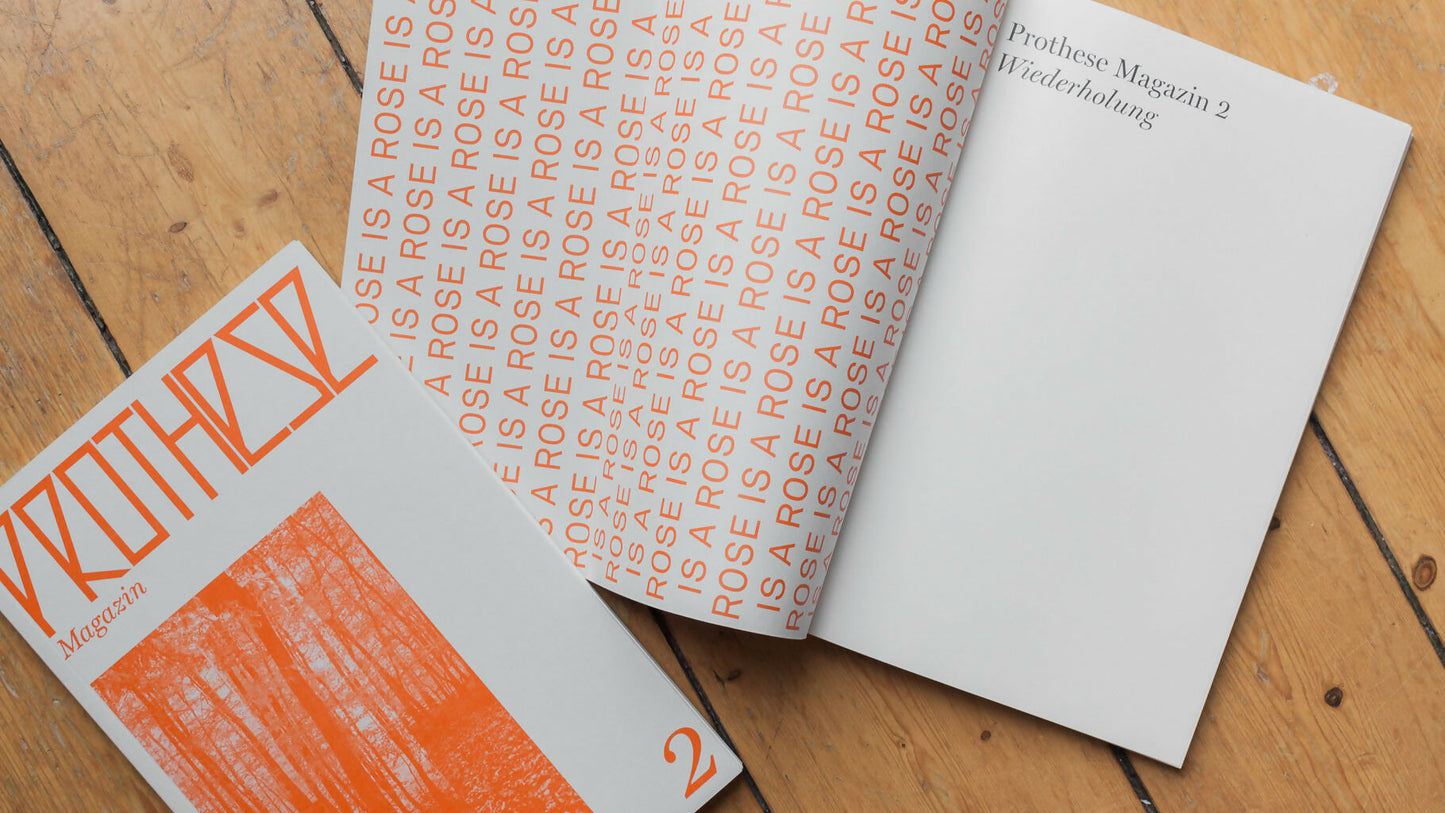
Topic: Repetition
Pages: 101
Nothing ever seems to change. The world is caught in a “racing standstill.” The idea that the end of the world is easier to imagine than the end of capitalism has long become a cliché: even the critique of the eternal recurrence of the same seems unchanging.
At the same time, there are events. Crises break open the hyperreal sphere of inevitable redundancies. Natural disasters, wars, and attacks are such crises. As are the refugee boats that capsize at sea, whose passengers cannot be rescued from drowning. These are events that cut through the ritualized time of everyday life into a before and after: a cut that, as an open wound in political consciousness, compels change, a rupture that turns amorphous time into distinguishable history.
This is something that cannot be resolved. The normative impulses that arise from these events are met with great helplessness. History has become a fate to which societies are subjected.
The political system, in its symbiosis with the bureaucratic apparatus, has become increasingly similar to it and has ultimately been absorbed by it. Politics is no longer the art of the possible, nor is it collective action, let alone the distinction between friend and foe. Today, politics is the management of simulations of human security. What remains political in the emphatic sense is a hollow phrase, a lie without any assertion of truth.
So, one is left to fend for oneself, observing events from a position of helpless privacy. From this private vantage point, the world seems very far away. World events have become almost unaddressable for the individual. Thus, one remains with the everyday and with redundancy, even when they feel cynically out of place in the face of a world ablaze. This paradox of the simultaneity of event and routine raises the question of sameness and otherness, precisely the question of repetition, of repeatability, and of what is no longer repeatable.
In the second issue of Prothese, we present works that explore phenomena and concepts of repetition from different perspectives.
We would like to especially thank Professor Michaela Ott for her guest contribution, Repetition as Philosophical and Artistic Differentiation.
Content:
Art W. Krüger / Limits of Imitation
Nina Kuttler / Unwelcome Guest
Sigrid Hermann / Repetitive Images — Viral Images — An Attempt at Explanation
Robert Weitkamp / Between David Guetta and Adorno. An Attempt at an Analogous Approach to Rave Culture
Luca Lienemann / I Pee Standing and Have 4G. A Brief Critique of the Jodel App
Joscha Blankenburg / Art
Judith Kissner / Dots
Florence Schreiber / Performance
Jan Boesken / Always New Again
Raphael Dillhof / On the Failed Repetition of Architectural History
Jakob Koppermann / From Farce to Tragedy. The Repeated Invention of Terrorism
Simon Gumprecht / Truth in the Age of Its Technical Reproducibility. On Truth and Lies in a Technological-Historical Sense
Hendrik Althoff / Hitler's Conception of Propaganda Language in Mein Kampf. Origins, Implementation, and Effects
Tim Burschyk / Gear G
Pia Schreiber / Crafting Meaning
Mirjam Groll / Bartleby or the (Im)Possibility of (Self-)Refusal
Carolin Rauen / I Couldn’t Stop Watching, and Suddenly Everything Was Different
Michaela Ott / Repetition as Philosophical and Artistic Differentiation
Tristan Xavier Köster / partita Trope
Catalina Rueda / between »between«
Pages: 101
Nothing ever seems to change. The world is caught in a “racing standstill.” The idea that the end of the world is easier to imagine than the end of capitalism has long become a cliché: even the critique of the eternal recurrence of the same seems unchanging.
At the same time, there are events. Crises break open the hyperreal sphere of inevitable redundancies. Natural disasters, wars, and attacks are such crises. As are the refugee boats that capsize at sea, whose passengers cannot be rescued from drowning. These are events that cut through the ritualized time of everyday life into a before and after: a cut that, as an open wound in political consciousness, compels change, a rupture that turns amorphous time into distinguishable history.
This is something that cannot be resolved. The normative impulses that arise from these events are met with great helplessness. History has become a fate to which societies are subjected.
The political system, in its symbiosis with the bureaucratic apparatus, has become increasingly similar to it and has ultimately been absorbed by it. Politics is no longer the art of the possible, nor is it collective action, let alone the distinction between friend and foe. Today, politics is the management of simulations of human security. What remains political in the emphatic sense is a hollow phrase, a lie without any assertion of truth.
So, one is left to fend for oneself, observing events from a position of helpless privacy. From this private vantage point, the world seems very far away. World events have become almost unaddressable for the individual. Thus, one remains with the everyday and with redundancy, even when they feel cynically out of place in the face of a world ablaze. This paradox of the simultaneity of event and routine raises the question of sameness and otherness, precisely the question of repetition, of repeatability, and of what is no longer repeatable.
In the second issue of Prothese, we present works that explore phenomena and concepts of repetition from different perspectives.
We would like to especially thank Professor Michaela Ott for her guest contribution, Repetition as Philosophical and Artistic Differentiation.
Content:
Art W. Krüger / Limits of Imitation
Nina Kuttler / Unwelcome Guest
Sigrid Hermann / Repetitive Images — Viral Images — An Attempt at Explanation
Robert Weitkamp / Between David Guetta and Adorno. An Attempt at an Analogous Approach to Rave Culture
Luca Lienemann / I Pee Standing and Have 4G. A Brief Critique of the Jodel App
Joscha Blankenburg / Art
Judith Kissner / Dots
Florence Schreiber / Performance
Jan Boesken / Always New Again
Raphael Dillhof / On the Failed Repetition of Architectural History
Jakob Koppermann / From Farce to Tragedy. The Repeated Invention of Terrorism
Simon Gumprecht / Truth in the Age of Its Technical Reproducibility. On Truth and Lies in a Technological-Historical Sense
Hendrik Althoff / Hitler's Conception of Propaganda Language in Mein Kampf. Origins, Implementation, and Effects
Tim Burschyk / Gear G
Pia Schreiber / Crafting Meaning
Mirjam Groll / Bartleby or the (Im)Possibility of (Self-)Refusal
Carolin Rauen / I Couldn’t Stop Watching, and Suddenly Everything Was Different
Michaela Ott / Repetition as Philosophical and Artistic Differentiation
Tristan Xavier Köster / partita Trope
Catalina Rueda / between »between«


—
💛 By visiting Prothese’s website, you’re supporting an independent publisher directly and contributing to a wider network of artists, readers and small presses beyond traditional channels.
This product is designed and sold by — Prothese
Country — Germany
Shipping information —
About —